“Diversity: the art of thinking independently together.”
— Malcolm Forbes
While teaching at East Carolina University in the fall of 2016, I had the pleasure of teaching a first-year composition course comprised completely of students with accommodations arrangements. There were twenty-five students in the course, all with different cognitive and/or physical diagnoses that impacted their learning in some way. In the interest of student privacy, accommodations letters do not disclose student medical information, and students are under no obligation to self-disclose. For this reason, it was extremely important that I approached preparing to teach the class with the myriad possibilities of student needs and their broad spectrum of learning styles in mind. There had to be a little something for almost everyone. I knew it would be difficult to work out a perfect teaching approach for all of them, but I wanted to get as possible.
Teaching that course transformed my personal philosophy in a number of ways. It walked me into a room full of opportunities to not only teach, but to learn. It sharpened my ear and changed the way that I listened as I experienced students sometimes asking the same question in different ways. It made me more attentive to language and shifted my perspectives on communication. It also deepened my connection to my students because it made me more thoughtful about who they are and how they learn. These shifts in thinking made me a better instructor and dismantled the myopically formulaic approach that had previously limited my teaching in various.
“I encourage students to identify what intimidates them and the deceptive metrics they use to assess themselves. When we have identified them, we can strategize ways to dismantle them and clear their pathway to skills acquisition”.
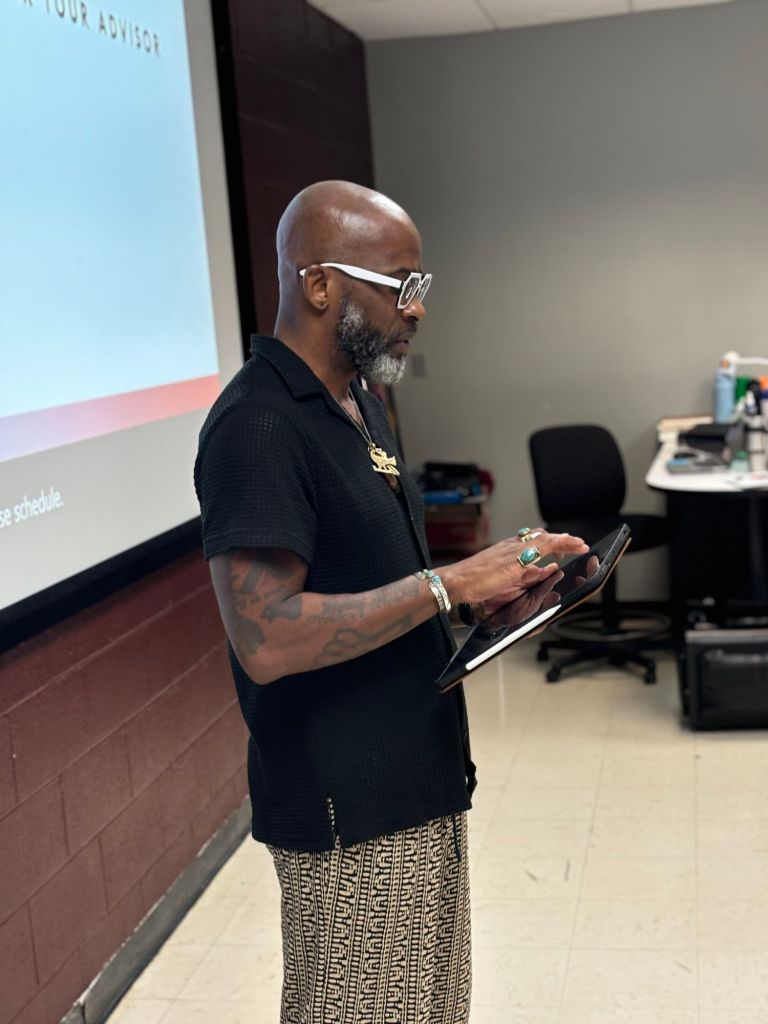
My teaching philosophy has undergone numerous revisions and reconsiderations each school year. It is now largely built around the importance of diversity—of experience and exposure, opportunities, and available methodologies. Though our current ethos bastardizes the diversity in problematic ways, it remains an inescapable and ever-present reality despite efforts to suppress it. That semester taught me to anticipate and welcome it while profoundly imploding the boundaries of what I knew diversity to mean. Because of the broad spectrum of humanities I was encountering, it was important to remain open to the infinite opportunities to learn and evolve that we were manifesting together. I learned, and adopted into my philosophy, that instructors must recognize, affirm, and validate the dynamic gifts of difference that meet them in the classroom. I believe maximum pedagogical effectiveness is the direct result of affirming pedagogies that integrate rather than alienate student experiences and perspectives into teaching and learning, and even curriculum selection when possible.
A primary goal of my teaching is to empower students with the tools they need in order to take advantage of learning opportunities with confidence and deepened interest. This is made possible by pointing to real world contexts in which the skills they are acquiring will prove indispensable to their success. We can achieve student buy-in by decentering our classrooms and presenting ourselves as learners also. A technique I have adopted that has effectively enhanced my student’s learning is to frame all lectures and discussions with questions rather than bombarding them with information or presenting myself as the only source. That might look like drafting an “audience” profile in a composition course or framing literature readings with questions about what texts have to tell us about what it means to be black, or a woman, or powerless. In the act of decentering, I help students piece together information “missions” that allow them to bring it together themselves, aided by my knowledge of the subject area. Collaborative learning increases student confidence and decreases the distance between their perceived level of proficiency and their ability to demonstrate mastery. For this reason, I encourage students to identify what intimidates them and the deceptive metrics they use to assess themselves. When we have identified them, we can strategize ways to dismantle them and clear their pathway to skills acquisition.
In addition to all of the above, I also try to play to my own strengths as an instructor. I have learned to ask myself questions about what I do well, and how I can use those things to the advantage of my teaching objectives. For example, beyond the classroom I write and perform spoken word poetry. Because of the close proximity between spoken word poetry and rap/hip-hop, it has proven to be a very effective medium for drawing students into discussions. As an example of how I use it, in preparation for teaching a lesson on Sojourner Truth’s “Ar’nt I a Woman?,” I wrote a poem entitled “How to emasculate a Black Woman.” In our discussion we brought Truth’s womanist politics into conversation with current conversations about “masculine” black women and the prominent “gender wars” that are birthed by our subscription to notions of race and gender. I opened the discussion with the poem, having woven the conversation I wanted to engage into the verses. My students responded positively, even asking that a video of the poem be posted online so that they could listen repeatedly. As another example, when teaching composition, if I ask my students to write personal narratives, I also draft a narrative and share it with them. It serves as an example of what I’m looking for and provides an opportunity to connect with them in a greater way when I engage their questions. I believe it is important to extinguish the intimidation factor that often stands between teachers and students. I share with them the areas where I need to improve my own writing and teach them to think critically about work.
“I have learned to ask myself questions about what I do well, and how I can use those things to the advantage of my teaching objectives.“
I also believe it is important to maintain cultural competence. By this I mean staying somewhat aware of the things that are current in student culture and technology. Because we live in an increasingly more digital age where the bulk of their consumption is either online or through various social media, cultural knowledge and technology have become extremely important to the ways we teach. I often use the controversies and narratives that circulate through the numerous digital spaces they interface with to foreground conversations about older concepts and events. Through this, I am able to demonstrate the continuity of politics that govern our societies and the relevance of foundational texts to the things they care about today. I use teaching methods that appeal to a variety of learning styles. To that end, I am mindful to include multiple mediums such as written texts, video, music, photography, art, and various other forms.
In sum, openness is invaluable to the professory because teaching tools exist all around us. I have learned to look for instructional opportunities in unlikely places and to consider genres and methods that, although unconventional, have great potential as teaching tools. Perhaps the greatest method of evaluating one’s effectiveness in using any strategy is its reproducibility. By this I mean, I believe it is not only important to teach students how to learn and provide them with information, it is important to teach them in a way that results in their ability to do the same. When our students can share their knowledge with accuracy, we have been successful in our practice.
North Carolina Central University
Durham, NC
 altariqmoore.com